

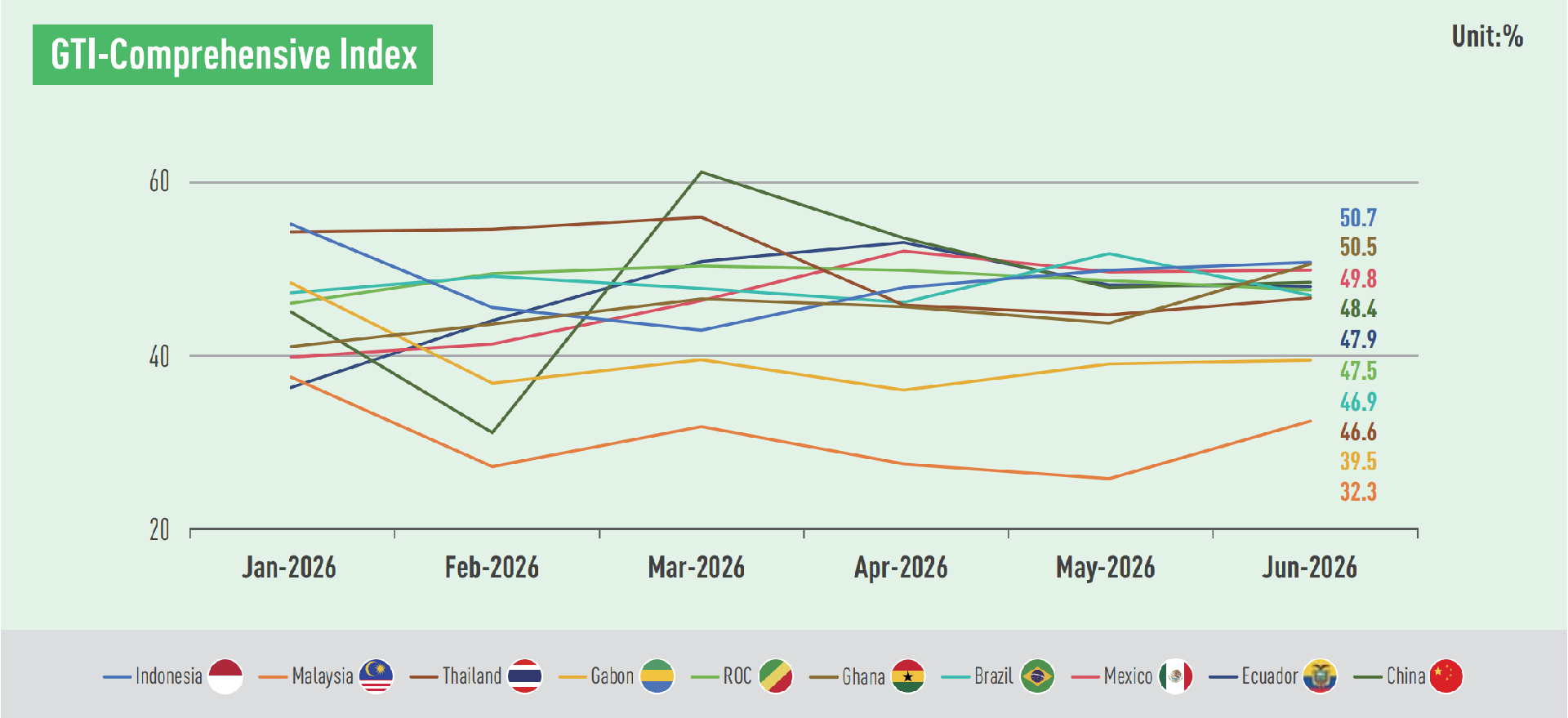
The Global Timber Index (GTI) Report for June 2026 revealed that among the ten GTI pilot countries, only Indonesia (50.7%) and Ghana (50.5%) registered GTI readings above the 50% critical value, signaling a slight expansion in their timber sectors compared to the previous month. The other eight countries were in contraction territory: Mexico (49.8%) and China (48.4%) posted readings close to the critical value, indicating slight contraction; Ecuador (47.9%), Republic of the Congo (47.5%), Brazil (46.9%), and Thailand (46.6%) showed moderate contraction; and Gabon (39.5%) and Malaysia (32.3%) recorded notably low readings, reflecting a significant downturn in their timber sectors.
The GTI sub-indices showed that both harvesting volume and production output rose in Indonesia and Mexico, while new orders increased in Indonesia, Ghana, and Brazil. The data also showed that Latin American pilot countries posted relatively strong timber export performances in the first half of 2026: Brazil’s sample enterprises saw their total export orders grow for six consecutive months; Mexico’s export market contracted only in April; and Ecuador’s export orders grew over the past three months, and during the first half of the year, a decline was recorded only in March.
Insufficient market demand stood out as a major concern raised by GTI sample enterprises. In response, the enterprises proposed a range of self-help measures, including strengthening market and channel development, promoting market diversification, expanding online promotion and sales, as well as slowing down production and optimizing inventory management. At the same time, governments and industry associations have actively worked to create a more favorable environment for timber industry exports through trade agreements and market development: Malaysia's Ministry of Investment, Trade and Industry (MITI) is actively expanding high-potential overseas markets for wood products, including China, South Korea, India, and others, in an effort to achieve this year's export growth target of 15 percent; Indonesian Furniture and Craft Industry Association highlighted Europe, East Asia, Australia and India as priority markets for expansion; Brazil’s Congress has approved the free trade agreement between Mercosur and the European Free Trade Association. The agreement regulates sustainable forest management and relevant trade matters, with parties pledging to promote trade in products that derive from sustainably managed forests. Ecuador is advancing trade agreement negotiations with Morocco and has listed timber as a priority category in the talks.
The pilot countries are accelerating their forest plantation efforts to strengthen the long term raw material supply base. Ghana, for example, has developed some 400,000 hectares of planted forests, and, on June 5, launched a large scale annual reforestation initiative targeting 30 million seedlings. However, extreme weather and climate risks continue to disrupt timber material supplies: In Indonesia, El Niño heightens fire risks, particularly during the peak dry season from July to September, prompting the government to reactivate its forest and land fire coordination mechanism; in Mexico, extreme weather has led to a widespread bark beetle infestation in forested areas across many regions, and the National Forestry Commission and local authorities have taken proactive prevention and control measures; in addition, GTI sample enterprises in countries like Thailand, Ghana, and Ecuador reported that rainfall hampered harvesting and transportation, and proposed countermeasures such as stockpiling raw materials in advance and stepping up road maintenance.
The EU Deforestation Regulation (EUDR) and the FLEGT mechanism are accelerating the development of digital traceability and legality certification systems in the relevant countries. In Thailand, 11 government agencies, including Agricultural Research Development Agency and the Royal Forest Department, recently jointly launched the “EUDR One Data Thailand” national data platform, which establishes a unified traceability system by integrating farmers’ records, land and geospatial information, forestry data, and production information. At the EU-Ghana Timber Trade and Investment Forum held in Nantes, France, the Forestry Commission of Ghana announced that approximately 626 Forest Law Enforcement, Governance and Trade (FLEGT) licenses have been issued, and to better align with the requirements of the EUDR, Ghana is strengthening its Timber Legality Assurance System (GhLAS), expanding the Timber Validation Committee, and will soon incorporate geolocation data into the FLEGT licensing framework. On June 9, at a meeting between the Republic of the Congo and the EU on the FLEGT Voluntary Partnership Agreement (VPA), it was noted that the timeline for issuing FLEGT licenses was tight and accelerated progress on VPA implementation was needed.
| E-mail:ggsc@itto-ggsc.org | Tel:86-10-66095281 |


Sigh Up for Emails |
|
